Cash book format with examples (single, double and three column)
A cash book records every cash receipt and payment in date order. Here are the standard formats, a worked example of each, and a simpler daily version for shops.
A cash book is a book of original entry in which all cash received and cash paid are recorded in date order. It does two jobs at once: it is a journal (where transactions are first written) and a ledger account for cash (it has a balance). The left side, the debit (Dr) side, shows receipts; the right side, the credit (Cr) side, shows payments.
At any time: closing balance = opening balance + receipts − payments. The cash book balance should always equal the cash actually in hand. A cash balance can never be negative — if your cash book shows more payments than cash available, an entry is missing or wrong.
Single column cash book
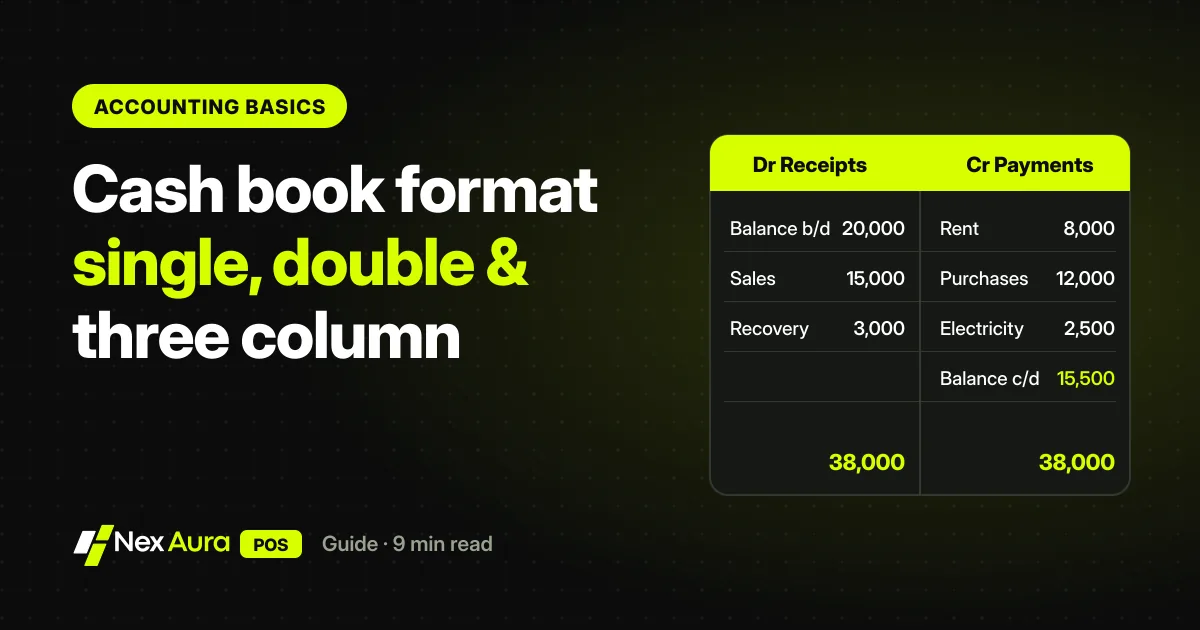
The simplest format, with one amount column on each side. It is used when a business deals only in cash.
Date
Particulars (Dr)
Amount (Rs)
Date
Particulars (Cr)
Amount (Rs)
1 Mar
To Balance b/d
20,000
2 Mar
By Rent
8,000
3 Mar
To Sales
15,000
4 Mar
By Purchases
12,000
5 Mar
To Ali (recovery)
3,000
6 Mar
By Electricity
2,500
7 Mar
By Balance c/d
15,500
Total
38,000
Total
38,000
Check: 20,000 + 15,000 + 3,000 − 8,000 − 12,000 − 2,500 = 15,500 closing balance, carried down to the next period as To Balance b/d.
Double column cash book (cash and bank)
Most businesses also use a bank account, so the cash book has two amount columns on each side: Cash and Bank. Money moved between cash and bank is a contra entry — it appears on both sides and is marked C.
Date
Particulars (Dr)
Cash
Bank
Date
Particulars (Cr)
Cash
Bank
1 Mar
To Balance b/d
10,000
50,000
2 Mar
By Bank (C)
8,000
2 Mar
To Cash (C)
8,000
4 Mar
By Supplier (cheque)
30,000
5 Mar
To Sales
12,000
6 Mar
By Wages
4,000
7 Mar
By Balance c/d
10,000
28,000
Total
22,000
58,000
Total
22,000
58,000
Depositing Rs 8,000 of cash into the bank reduces cash (credit side, cash column) and increases bank (debit side, bank column). The business is no richer or poorer — that is why it is a contra entry.
Three column cash book (cash, bank and discount)
The three column cash book adds a Discount column on each side:
Discount allowed (debit side) — discount you give a customer who pays early.
Discount received (credit side) — discount a supplier gives you.
The discount columns are not balanced like cash and bank; their totals are posted to the Discount Allowed and Discount Received accounts in the ledger.
Date
Particulars (Dr)
Discount
Cash
Bank
3 Mar
To Bilal (paid Rs 9,800 on Rs 10,000)
200
9,800
On the credit side, paying a supplier Rs 19,500 against a bill of Rs 20,000 would show Discount 500 and Bank 19,500.
A simple daily cash book for shops
Shops rarely need textbook columns. A practical daily cash book has:
Time
Cash in (Rs)
Category
Cash out (Rs)
Category
Note
Opening
5,000
Previous balance
10:30
7,200
Daily sale
morning sales
12:00
2,000
Udhaar recovery
Imran sahib
14:00
1,500
Expense — tea & meals
18:00
6,000
Supplier payment
wholesaler
Closing
= 5,000 + 9,200 − 7,500 = 6,700
Count the drawer at closing. If it shows Rs 6,700, the day is right; if not, the difference is a missing entry or an error to find today, while everyone still remembers.
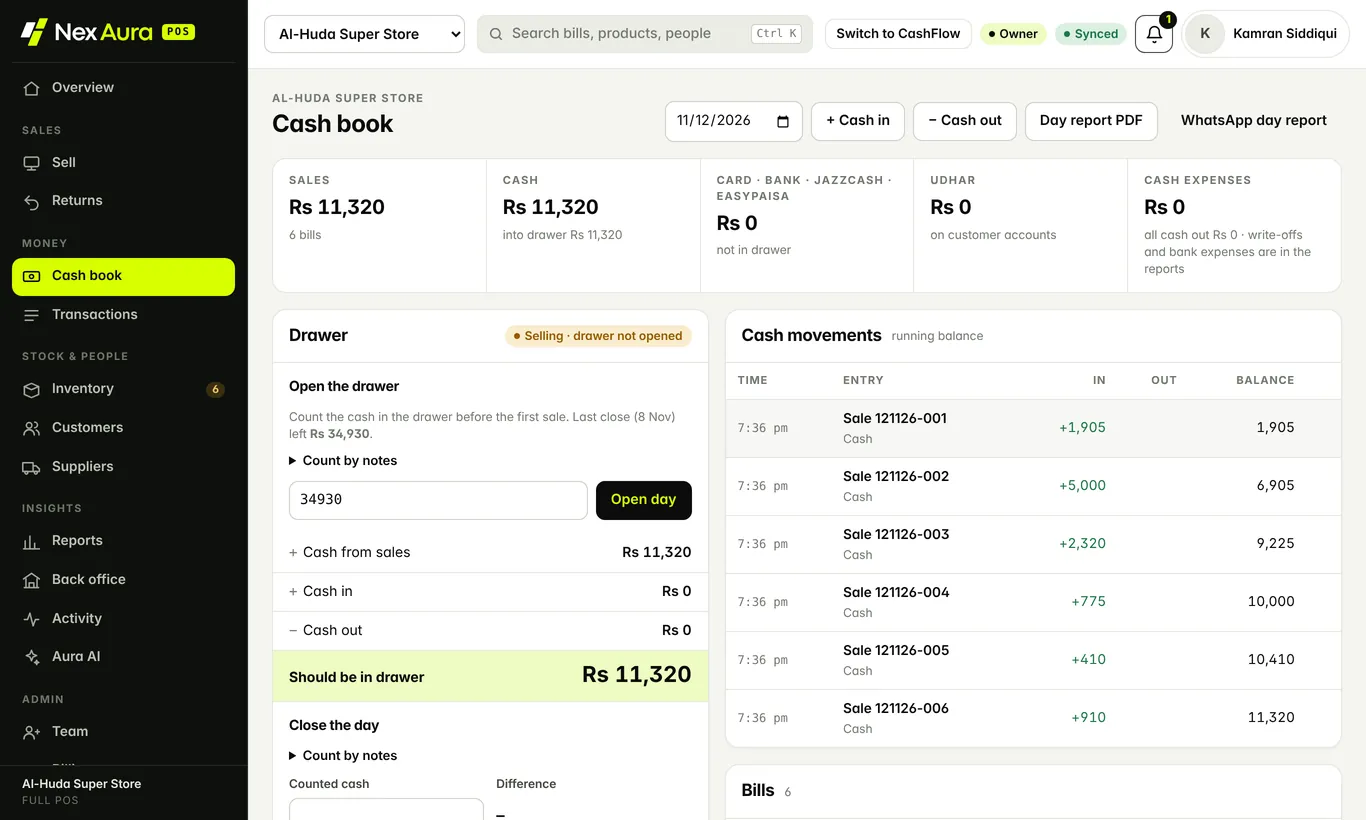
In Excel this is a sheet with the columns above and a closing formula; in shop software such as NexAura POS the categories, closing balance and reports are calculated for you — see cash book & profit-loss.
A daily cash book kept by software: opening cash, every sale and expense with a running balance, and the closing count. (NexAura POS, sample data.)
Common cash book mistakes
Recording udhaar sales as cash. Credit sales belong in the customer's account, not in cash — record the cash only when it is recovered.
Forgetting small expenses paid from the drawer. Keep a petty cash book for these (see the petty cash book format).
Mixing personal and shop cash. Owner withdrawals are recorded as drawings, not as expenses.
Not carrying the balance forward. Each day or month should start with the previous closing balance.
Missing contra entries when moving money between cash and bank.
Quick revision
Debit side = receipts; credit side = payments.
Closing balance = opening + receipts − payments, and can never be negative.
Double column = cash + bank; contra entries marked C.
Three column = cash + bank + discount; discount columns are totalled, not balanced.
Invoice meaning in simple words: what an invoice includes, how to write one, invoice number formats, types of invoice, invoice vs receipt, and a free template.
What a petty cash book is, how the imprest system works, the analytical petty cash book format and a worked example you can copy for your shop or office.