
Inventory & Purchases
Inventory management for small shops: a practical guide
Simple inventory management for small Pakistani shops: what to count, how often, reorder levels, slow stock, Excel vs software and the mistakes that cost money.
A stationery and book shop lives by the school calendar. Plan for the season, control credit and watch margins on small items.
Most stationery and book shops make a large share of the year's sales in a few weeks: the start of the academic session, exams and the return after summer holidays. Plan backwards from those dates:
| Group | Examples | Approach |
|---|---|---|
| Seasonal | Book sets, syllabus books | Order to booked demand; agree returns |
| Fast movers | Registers, pens, notebooks, files | Reorder levels; never run out |
| Slow / premium | Art supplies, gifts, office items | Small quantities; review every quarter |
Small items have small margins individually but sell in large numbers, so a price mistake on a fast mover costs more than one on a premium item.
Publishers and wholesalers often supply on credit before the season. Keep a ledger for every supplier — purchases, returns and payments — and check it before every payment. Ask for a statement after the season and match it to your ledger.
During the rush it is tempting to "count tomorrow". Don't. Close every day: opening balance, cash in (sales, recoveries), cash out (expenses, supplier payments), closing balance — and match it with the drawer. A simple daily cash book format is enough.
After each season, calculate gross profit and net profit for the season and compare with last year. Big sales with thin margins and high udhaar can leave less profit than a quieter year. See how to calculate shop profit and loss.
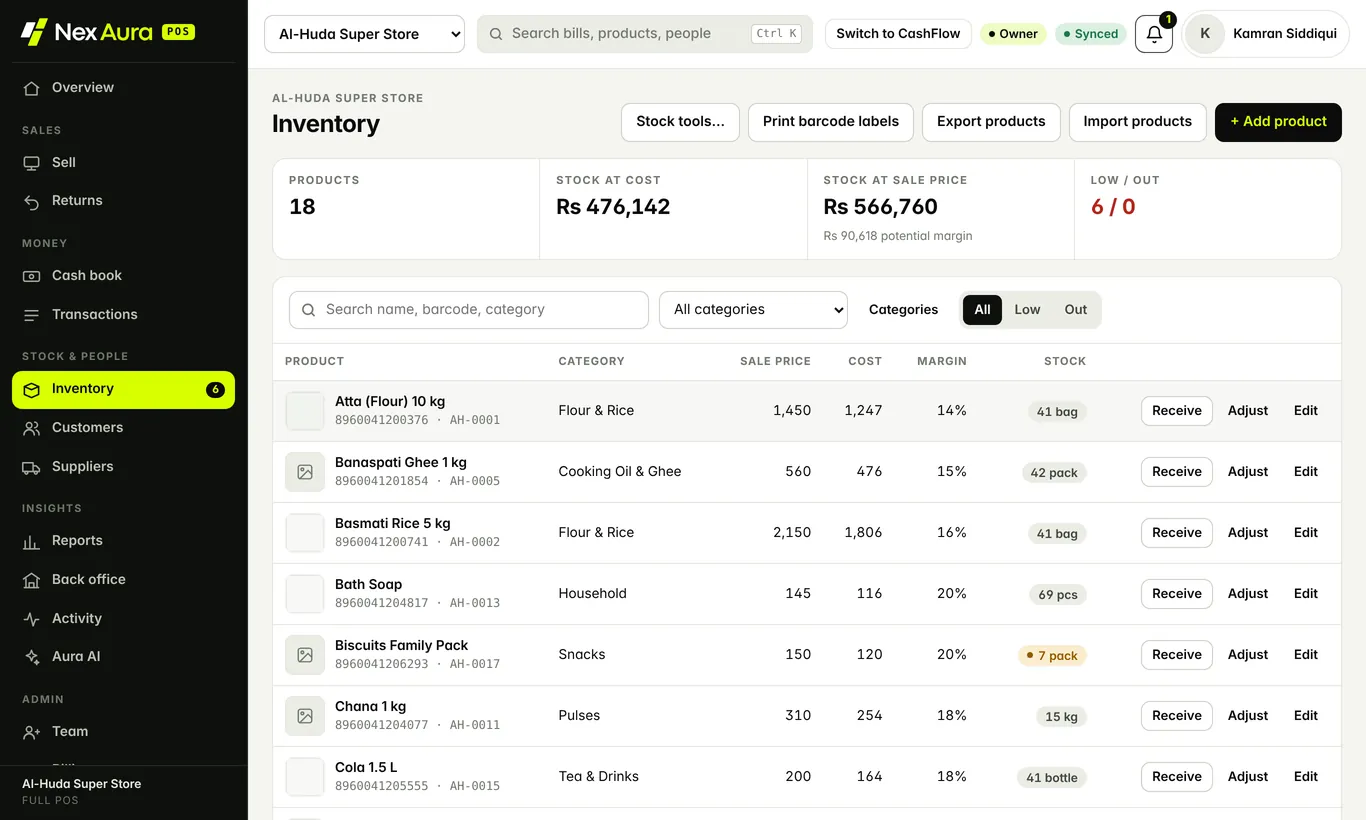
NexAura POS is used to run a book, stationery and sports shop, and is built around these needs: a khata for every customer and school, supplier ledgers, a daily cash book with closing balance, and profit & loss with compare periods — see book & stationery shop software. If you also run another business, both can sit under one login.
Simple inventory management for small Pakistani shops: what to count, how often, reorder levels, slow stock, Excel vs software and the mistakes that cost money.
Practical udhaar khata management for Pakistani shops: credit limits, recording rules, recovery routines and polite ways to collect udhaar without losing customers.
How to choose POS software in Pakistan: what to check on price, billing, stock, udhaar, offline use, reports and support — and the kinds of POS you will find.
Start a 14-day free trial — no payment needed. Set up your business, add products or import them from Excel, and make your first bill today.